
Scales & Theory
What is a passing chord? 4 ways to make guitar chord progressions sound better
Nov
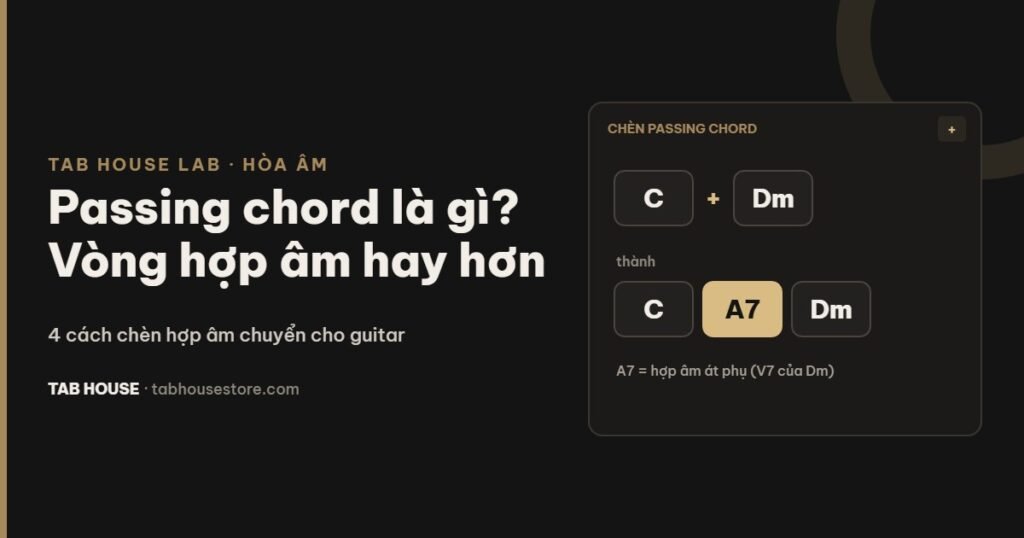
You're strumming a familiar song with C – Am – Dm – G. Right chords, right rhythm, but it still sounds “flat”, not like the singer's recording. Very often the difference is a few short chords slipped in between the main chords. Those are passing chords.
What is a passing chord?
A passing chord is a short chord, usually lasting 1–2 beats, placed between two main chords to make the move from one to the other smoother or more colourful. It doesn't change the song's melody, it just gives the accompaniment more “direction”.
4 common ways to add passing chords
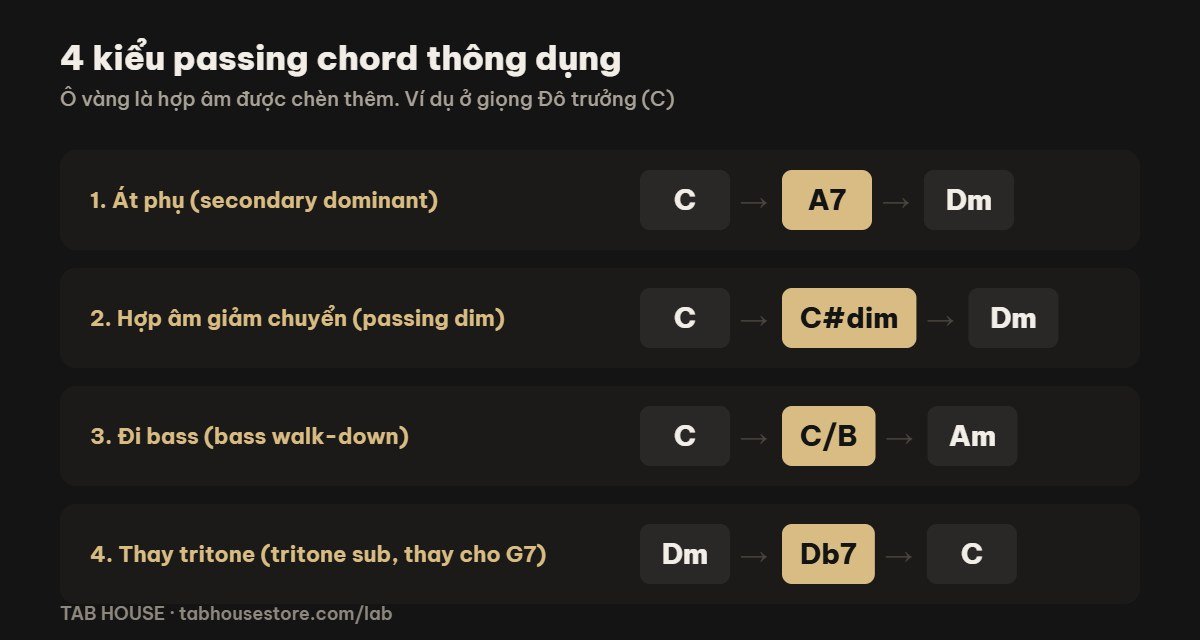
1. Secondary dominants
Before any chord, add the 7 chord whose root is a fifth above it. To go to Dm, add A7: C → A7 → Dm. To go to Am, add E7: C → E7 → Am. The 7 chord creates a very clear “pull” towards the target chord. This is the easiest approach for pop and ballads.
2. Passing diminished chords
When two chords have roots a whole step apart, put a diminished chord in between: C → C#dim → Dm, or F → F#dim → G. The bass line rises by half steps and sounds very “classical”.
3. Bass walk-downs
Keep the chord shape and just change the bass note to walk down step by step: C → C/B → Am, or longer: C → C/B → Am → Am/G → F. This suits rhythm guitar perfectly because you only change one finger.
4. Thay tritone (tritone substitution)
Replace the dominant chord (G7 in C) with the 7 chord a tritone away: Db7. The progression Dm → Db7 → C has a bass line that walks down by half steps D – Db – C and sounds more “jazzy”. Use it sparingly in pop.
When shouldn't you add passing chords?
- When the melody note clashes with the passing chord (for example the melody holds a C while you add C#dim): test it by ear first.
- When the song needs to stay simple and stripped back: too many make the accompaniment cluttered.
- When you can't change the main chords smoothly yet: practise the basic progression first, add passing chords later.
Try it quickly in Tab House Lab
Thinking up a passing chord is easy; finding a fingering that moves smoothly is what takes time. Tab House Lab is the Tab House tool that helps with this: enter your progression, tap the + between two chords to see the ways to move between them, tap a chord to see substitutions. Fingerings are arranged to sound smooth, and the Scale, Arpeggio, Voicing, Analysis and Metronome tabs follow the exact progression you're practising.
Lab can also detect chords from a song file (mp3, wav, m4a): it recognises chords (about 170 types, including 7ths, 9ths and inversions), tempo, beats and key. Tab House's AI model can be wrong in some sections, so you still need to listen back and fix the bars that aren't right.
Frequently asked questions
Is a passing chord the same as a substitution?
Not quite. A substitution replaces an existing chord; a passing chord is added in between. The tritone sub sits in the middle: you replace G7 with Db7 and then use it as a passing chord.
Should beginners learn passing chords?
Start with secondary dominants and bass walks, because you only need a few familiar shapes like A7, E7 and C/B.
Read next: maj7, m7 and 7 chords on guitar and the circle of fifths for guitar.
