
Scales & Theory
What is a target note? How to solo over the chords with chord tones
Nov
You know the pentatonic scale and can run up and down it pretty fast. But when you put on a backing track to solo, every line sounds the same, and lots of spots sound “off” the chords even though no note is outside the scale. This is where a lot of guitar players get stuck.
The reason: a scale only tells you which notes you're allowed to play, but not which note should land where. What solves that is target notes and chord tones.
What is a chord tone?
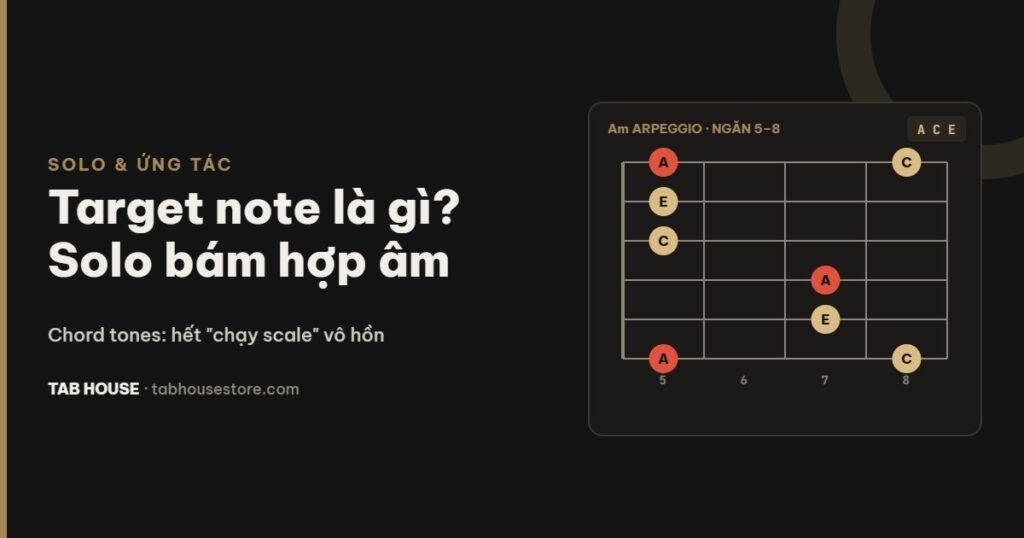
Chord tones are the notes that make up a chord. For example Am is A – C – E, Dm is D – F – A, E7 is E – G# – B – D. While Am is ringing, playing A, C or E sounds “locked in” immediately; other scale notes still work, but they feel suspended and want to move on to a chord tone.
What is a target note?
A target note is a chord tone you deliberately aim for, usually placed on a strong beat (beat 1 or 3), right when the chord changes. Instead of letting your fingers run on habit, you decide in advance: “when it goes to Dm, my line will land on F”. The rest of the solo is just the path to that note.
Why aim for the 3rd?
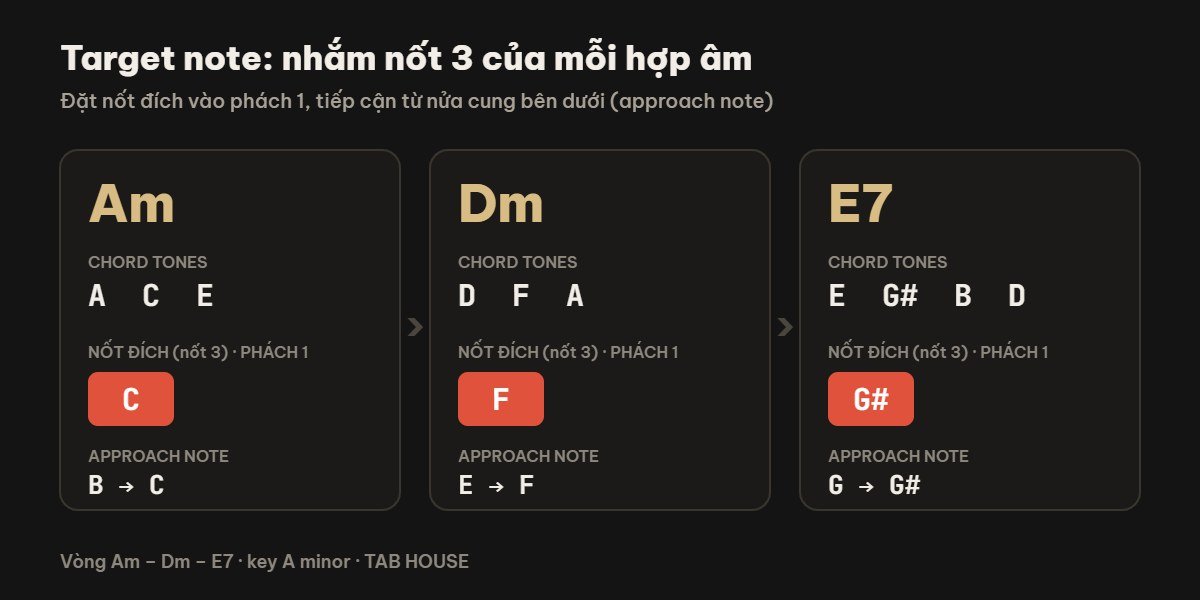
The 3rd decides whether a chord is major or minor. The root (A in Am) sounds safe but a bit “flat”; the 3rd (C in Am) lets the listener hear the chord's colour immediately. For Am – Dm – E7 in A minor:
- Am: target note C
- Dm: target note F
- E7: target note G# (this note isn't in the natural A minor scale; played in the right place it creates a very strong “pull” back to Am)
3 steps to build a solo with target notes
Step 1: learn the arpeggio of each chord in one position
Pick one area of the neck (for example around the 5th fret) and find A – C – E, D – F – A, E – G# – B – D in that area. Play each arpeggio slowly, saying the note names out loud. If you're not familiar with arpeggios yet, read guitar arpeggios for beginners.
Step 2: play only the target note, on beat 1
Put on a backing track and, each time the chord changes, play just one note: the 3rd of the new chord, right on beat 1. It sounds simple, but this exercise teaches your hand where the target note is in advance.
Step 3: add approach notes and connect the lines
An approach note sits right next to the target note, usually a half step below or a whole step above, played just before the strong beat: B → C, E → F, G → G#. Then fill the gaps between target notes with the scale. Now your solo has clear “destinations” and sounds like it's following the chords instead of just running scales.
Common mistakes when starting out
- Landing on the target note but off the beat: the right note at the wrong time loses most of that “locked in” feeling.
- Playing too many notes: leave space between phrases and the target notes will stand out more.
- Only aiming for the root: safe but bland. Try the 3rd, and the 7th on 7th chords.
Practise with a plan
If you'd like a complete learning path for this method, the course Improvise: Target Note & Chord Tones from Tab House goes from chord tone mapping (7 diatonic arpeggios plus E7 in Shape G, key of Am), choosing target notes, strong and weak beats and approach notes, to building solos over 2 backing tracks (Natural Minor and Harmonic Minor). It includes a 44-page PDF, 30+ videos, 3 backing tracks and 2 example solos.
Frequently asked questions
Do I need music theory to learn target notes?
You only need to know the note names on the neck and which notes make up a chord. The rest is ear and hand training.
What styles do target notes work for?
Almost any style with clear chord changes: pop, ballads, blues, rock, R&B, jazz. The faster the chords change, the more useful target notes become.
Read next: practising solos with a backing track and the 5 pentatonic positions.
