

Scales & Theory
The Circle of Fifths made easy for guitar
Oct
You hear people say “this song is in D, it has 2 sharps”, “a ii – V – I progression”… you nod along, but inside there's a big question mark. Looking at the circle of fifths diagram only makes it more confusing.
Actually the circle of fifths is a very practical map. Once you understand it, you'll know what key a song is in, which chords tend to go together, and you'll transpose much faster.
What is the circle of fifths?
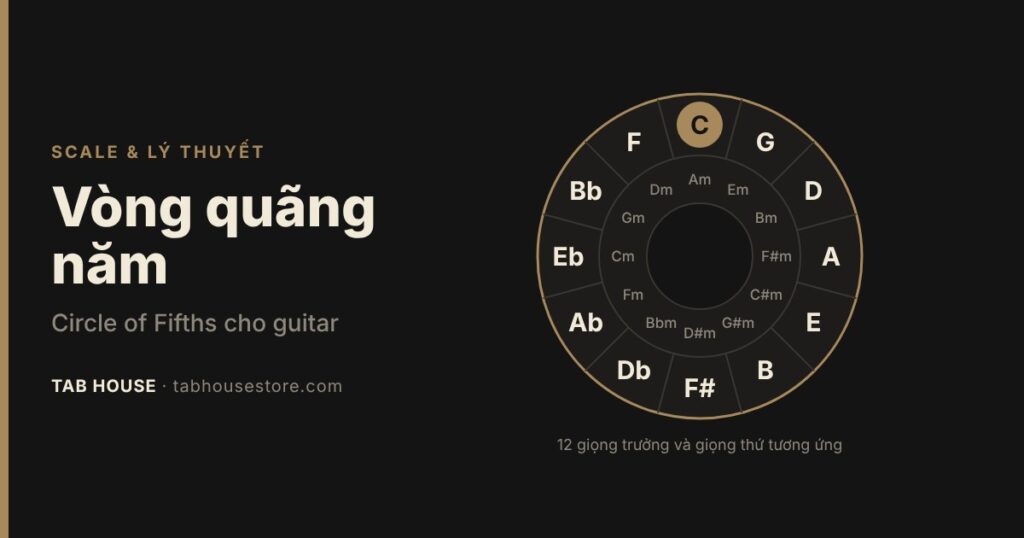
It's the 12 major keys arranged in a circle. Going clockwise, each step moves up a fifth and adds one sharp:
C – G – D – A – E – B – F#/Gb – Db – Ab – Eb – Bb – F
Going anticlockwise moves up a fourth, and the keys gradually add flats.
| Major key | Key signature | Relative minor |
|---|---|---|
| C | 0 | Am |
| G | 1 sharp | Em |
| D | 2 sharps | Bm |
| A | 3 sharps | F#m |
| E | 4 sharps | C#m |
| B | 5 sharps | G#m |
| F# / Gb | 6 sharps / 6 flats | D#m / Ebm |
| Db | 5 flats | Bbm |
| Ab | 4 flats | Fm |
| Eb | 3 flats | Cm |
| Bb | 2 flats | Gm |
| F | 1 flat | Dm |
The relative minor shares the same notes as the major key; for example Am and C both have no sharps or flats.
What is the circle of fifths for?
1. Knowing which chords go together
Pick a key on the circle: its two neighbours are the IV and V chords. For example in C the neighbours are F and G. Add the three relative minors Am, Dm and Em and you have almost all the chords in the key of C: C, Dm, Em, F, G, Am (and Bdim). Most pop songs in C only use chords from this group.
2. Understanding why progressions “sound right”
Lots of progressions move anticlockwise around the circle. For example ii – V – I in C is Dm – G – C: from D to G to C, one notch at a time. That's why G7 sounds like it “wants” to go to C.
3. Transposing and choosing scales
Knowing the song's key tells you which scale to solo with. A song in Am means A minor pentatonic; a song in Em means moving the shape to E.
A fretboard tip
The four low strings E – A – D – G are tuned a fourth apart. So at the same fret:
- Moving to the next higher string (string 6 to string 5) goes up a fourth, which means moving anticlockwise one step. For example string 6 fret 3 is G, string 5 fret 3 is C, string 4 fret 3 is F.
- Moving to the next lower string means moving theo clockwise one step (up a fifth).
- This works for strings 6, 5, 4 and 3. From the G string to the B string it's different, because those two are a third apart.
3 common mistakes
- Trying to memorise the whole diagram: just remember the order C G D A E B F#, and you can work out the rest.
- Mixing up a major key and its relative minor: Am and C have the same notes but a different home note.
- Learning theory without applying it: open a song you're practising and try to work out its key.
Frequently asked questions
Do I need to memorise the circle of fifths?
Memorise the sharp order C G D A E B F#. The flat side is just reading backwards from F: F Bb Eb Ab Db Gb.
How can I tell what key a song is in?
Look at the first and last chords, then check whether the other chords belong to the same group of neighbours on the circle.
How does the circle of fifths help with soloing?
Knowing the key means choosing the right scale, and knowing which notes belong to the chord to end your phrases on.
Keep practising with TabHouse
- Circle Of Fifths: click each key to see its key signature and diatonic chords.
- Chord Analyzer: check the notes in the chords of a song.
- Scale Finder to choose a scale by key.
