

Scales & Theory
maj7, m7 and 7 chords on guitar: how they differ and how to play them
Oct
Listen to Japanese city pop, neo soul or R&B and you'll notice the guitar sounds “dreamy”, classier and softer than regular pop. Most of the secret is in three chord types: maj7, m7 and 7.
This article explains how they differ, how to play them on electric guitar, and progressions you can play right away.
The formulas for the 3 chords
All three are 4-note chords: take a familiar 3-note chord and add a 7th. For example with a C root:
- Cmaj7 (C major seventh): 1 – 3 – 5 – 7 = C E G B
- C7 (C seventh, or “dominant seventh”): 1 – 3 – 5 – b7 = C E G Bb
- Cm7 (C minor seventh): 1 – b3 – 5 – b7 = C Eb G Bb
Just remember: maj7 uses the major 7th (a half step below the octave, for example B against C), while 7 and m7 use the b7 (a whole step below the octave, for example Bb against C). The difference between 7 and m7 is the 3rd.
How do they sound different?
- maj7: bright, dreamy, “floating”. The sound of city pop, bossa nova and ballads.
- m7: soft, gently sad, relaxed. Very common in funk, R&B and neo soul.
- 7: tense, wanting to move on to another chord. The foundation of blues and the “leading” chord in jazz and pop.
The quickest way to get it is to play C, then Cmaj7, then C7 in a row and notice how the feeling changes.
Root-5 shapes (the easiest to use)
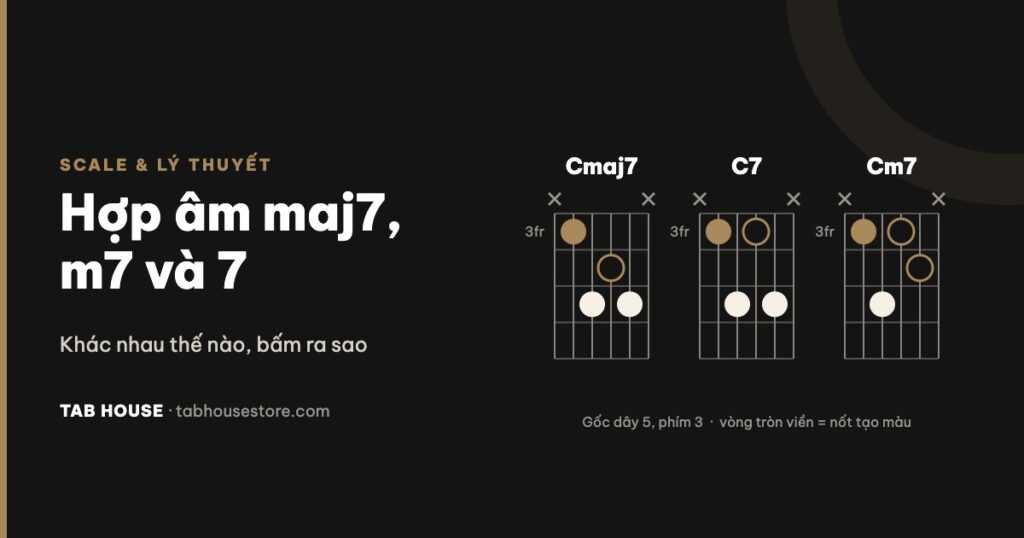
The three shapes below only use strings 5 to 2, with strings 6 and 1 muted. This is the most “ear-friendly” size for electric guitar: tight and never muddy.
     Cmaj7   C7   Cm7
e|---x-----x-----x---|
B|---5-----5-----4---|
G|---4-----3-----3---|
D|---5-----5-----5---|
A|---3-----3-----3---|
E|---x-----x-----x---|
Notice only one or two notes change between the chords: the G string (7 or b7) and the B string (3 or b3). Move the whole shape up or down to get the same chord type on another root, for example 2 frets up gives Dmaj7, D7, Dm7.
Root-6 shapes
     Gmaj7   G7   Gm7
e|---x-----x-----x---|
B|---3-----3-----3---|
G|---4-----4-----3---|
D|---4-----3-----3---|
A|---x-----x-----x---|
E|---3-----3-----3---|
String 5 is muted by the pad of the finger fretting string 6 touching it lightly. Gm7 is the easiest shape: finger 1 on fret 3 of string 6, finger 3 barring the 3 middle strings at fret 3.
Progressions to play right away
1. ii – V – I in C major: Dm7 – G7 – Cmaj7
The classic progression of jazz, pop and city pop. Dm7 is the root-5 shape at fret 5, G7 root-6 at fret 3, Cmaj7 root-5 at fret 3. Your hand barely has to move.
     Dm7   G7   Cmaj7
e|---x-----x-----x---|
B|---6-----3-----5---|
G|---5-----4-----4---|
D|---7-----3-----5---|
A|---5-----x-----3---|
E|---x-----3-----x---|
2. City pop progression: Fmaj7 – E7 – Am7
The IVmaj7 – III7 – vim7 sequence appears in loads of city pop and R&B songs. Play Fmaj7 root-6 at fret 1, E7 root-6 at fret 0, Am7 root-6 at fret 5.
     Fmaj7   E7   Am7
e|---x-----x-----x---|
B|---1-----0-----5---|
G|---2-----1-----5---|
D|---2-----0-----5---|
A|---x-----x-----x---|
E|---1-----0-----5---|
Add Gm7 – C7 after Am7 and go back to Fmaj7, and you have a very “chill” 4-bar loop to practise light strumming or fingerpicking.
Soloing over these chords
- Over maj7: lean on the 7th (B over Cmaj7), the note that creates the dreamy colour.
- Over m7: use scale Dorian or the minor pentatonic.
- Over 7: use scale Mixolydian, emphasising the major 3rd.
- Learn arpeggio of each chord so your solos follow the harmony closely.
Common problems
- Strings 1 and 6 ringing: the shapes above need the two outer strings muted. Strum lightly and aim only for the 4 middle strings.
- Mixing up Cmaj7 and C7: read the symbol carefully: “maj”, “M” or a triangle (CΔ7) means major seventh; just the number 7 means dominant seventh.
- Too much gain: 4-note chords through distortion sound very muddy. Use a clean tone with a little chorus and reverb for that true city pop sound.
Frequently asked questions
Are CM7 and Cm7 different?
Completely. CM7 (capital M) is Cmaj7, while Cm7 (lower-case m) is C minor seventh. Some charts also write Cm7 as C-7.
What is an m7b5 chord?
Like m7 but with the 5th lowered a half step: 1 – b3 – b5 – b7. For example Bm7b5 = B D F A. It usually comes before a 7 chord in minor-key progressions.
How can I quickly look up an unfamiliar chord?
Use the Chord Analyzer tool to see how it's built, and Voicing Generator to find more shapes on the neck.
Keep practising with TabHouse
- Voicing Generator: find maj7, m7 and 7 shapes in every position.
- The circle of fifths to understand why ii – V – I sounds so “natural”.
- Tab & backing track city pop to apply it to real songs.

Pingback: What is a passing chord? 4 ways to add passing chords on guitar | Tab House