

Technique
Guitar for complete beginners: an 8-week plan from zero

Nov
You buy a guitar, watch a few videos online, practise for a few days, then your fingers hurt, the chords buzz, you can't change chords in time, and the guitar ends up in a corner. Almost everyone who teaches themselves guitar goes through this. The problem usually isn't talent, it's practising in the wrong order: learning too many things at once, or jumping straight into hard songs.
This article is an 8-week plan for complete beginners starting from zero, about 20–30 minutes a day. It works for acoustic, electric and nylon guitar.
Before you start: 3 things to get right from day one
1. How to sit and hold the guitar
Sit up straight with the body of the guitar resting on your right thigh (if you're right-handed) and the neck angled slightly up. Put your left thumb behind the neck, around the middle, without squeezing. Most beginners' sore hands and shoulders come from tensing the wrist and squeezing the neck too hard.
2. Tune up every time you practise
If your guitar is out of tune, even correct playing sounds wrong, and your ear gets used to the wrong pitch. Use a tuning app or a clip-on tuner and tune to standard E (E A D G B E) before every session. See also: how to tune your guitar.
3. Fret close to the fret wire
Press with your fingertip right behind the fret wire, keeping your fingers upright so they don't touch the next string. Fretting close to the fret needs less pressure and sounds clearer.
An 8-week plan for beginners
Weeks 1–2: get your hands used to your first 4 chords
Start with Em, Am, C and G. These four chords appear in a huge number of popular songs, and the shapes aren't too hard.
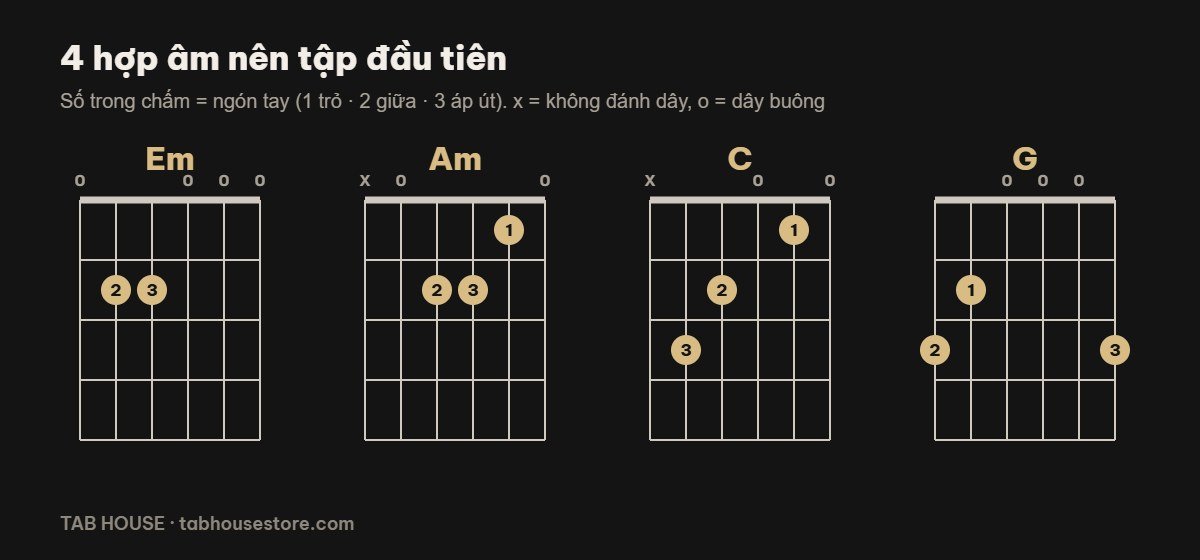
How to practise: fret each chord and pick one string at a time from top to bottom. If a string buzzes or is muted, adjust your fingers until all 6 strings (or 5 for Am and C) ring clearly. Don't rush into strumming; at this stage a clean sound matters more than speed.
Weeks 3–4: chord changes and basic strumming
Practise changing in pairs: Em ↔ Am, Am ↔ C, C ↔ G. Count 4 beats per chord and change right on beat 1. Once the changes are smooth, add the simplest strum: 4 downstrokes per bar, then move on to down – down – up – up – down – up.
Tip: picture the next chord shape in your head before changing, and keep any finger shared by both chords on the string (for example from Am to C keep fingers 1 and 2 in place).
Weeks 5–6: more chords and your first song
Add D, Dm, E and a simple F (4 strings). Pick a slow song with only 3–4 chords and accompany it from start to finish. Use a metronome at about 60–70 BPM; the most important thing is not to stop when you change chords.
Weeks 7–8: play whole songs and keep time
Raise the metronome speed gradually, 5 BPM at a time. Try humming the song while you strum. By the end of week 8, the goal is to accompany 2–3 familiar songs all the way through without looking at your hands too much.
5 common beginner mistakes
- Cramming an hour in one go, then resting all week. 20 minutes a day beats 2 hours every weekend.
- Skipping tuning. An out-of-tune guitar makes you think you're fretting wrong.
- Pressing too hard. It hurts your hand and slows your chord changes. Use just enough pressure to stop the string buzzing.
- Learning hard songs too soon. It's easy to get discouraged. Start with slow songs with few chords.
- Not counting. The right chords in the wrong rhythm still won't sound like the song.
Should I teach myself or follow a course?
Teaching yourself is perfectly possible, but beginners lose the most time not knowing what to practise first, what comes next and whether they're doing it right. A course with a clear lesson order and answers lets you skip that trial and error.
If you'd like a ready-made path, take a look at the Tab House Guitar Beginner course: 44 pages with answers to the exercises, 16 basic chords with real photos of hand positions, 7 practice songs with strumming exercises and 40+ video lessons. Works on acoustic, electric and nylon guitar.
Frequently asked questions
Can older adults learn guitar?
Yes. Stiffer hands may need a few extra weeks to adapt, but what really matters is practising every day.
How long until I can play a song?
If you practise 20–30 minutes a day with the plan above, most beginners can accompany a simple song after about 4–8 weeks.
Should I start on acoustic or electric guitar?
Either works. Electric guitars have lighter strings so they're easier on your fingers; acoustics are portable and need no amp. Choose the one you most enjoy playing, because that's the one you'll pick up the most.
Read next: how to read guitar tab from A to Z and power chords for beginners.
